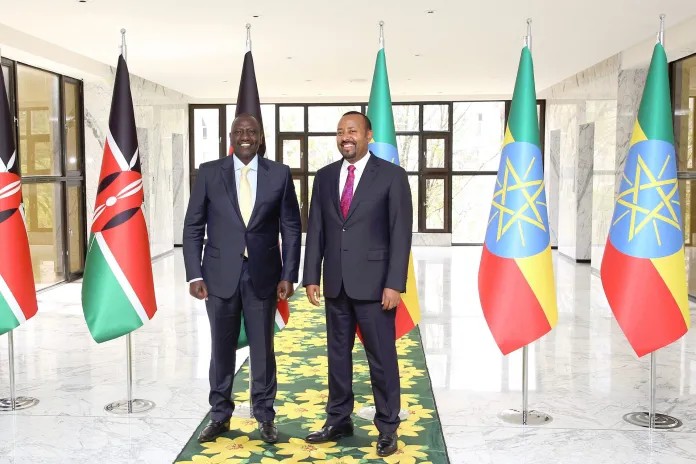
Israel’s decision on December 26 to recognize Somaliland as an independent state has triggered a major geopolitical shock across the Horn of Africa, forcing key regional powers—particularly Kenya and Ethiopia—to reassess their diplomatic positioning.
The Federal Government of Somalia immediately condemned the move as “illegal” and a violation of Somalia’s sovereignty, pledging to pursue diplomatic measures to overturn the decision.
At the continental level, the African Union swiftly rejected Israel’s recognition, warning that it could inflame new regional tensions and undermine Africa’s long-standing principle of respecting inherited borders. AU officials fear the move could embolden separatist movements elsewhere on the continent, further complicating already fragile border disputes.
The timing of the recognition adds to its significance. The Horn of Africa is already grappling with serious security challenges, including instability in Sudan and ongoing insecurity in Somalia. Meanwhile, the Red Sea and the Gulf of Aden remain vital commercial and military corridors, heightening concerns that diplomatic rivalries could evolve into competition over ports and maritime influence.
Ethiopia’s Policy of Strategic Silence
Ethiopia finds itself in an especially delicate position. Addis Ababa signed a Memorandum of Understanding with Somaliland in January 2024 that would grant Ethiopia access to the sea in exchange for recognition—an agreement that already strained relations with Somalia.
Israel’s recognition now places additional pressure on the government of Abiy Ahmed. Rather than issuing an immediate and clear response, Ethiopia has opted for strategic silence, attempting to balance its long-term maritime ambitions against the risk of openly defying African Union principles and further damaging ties with Mogadishu.
Security analysts note that Ethiopia’s defense and economic institutions continue to view access to trade corridors as an existential priority, making neutrality increasingly difficult to sustain.
Kenya: Balancing Conflicting Interests
Kenya, too, faces a complex diplomatic equation. Nairobi has traditionally aligned itself with the African Union’s position on territorial integrity, yet it maintains practical engagement with Somaliland, including a representative office in Hargeisa.
Israel’s move narrows Kenya’s diplomatic room for maneuver. While Nairobi publicly supports Somalia’s sovereignty, it has avoided direct criticism of Israel, reflecting its strong bilateral relationship with Tel Aviv.
Any step by Kenya that appears to legitimize Somaliland could undermine its security cooperation with Mogadishu. Conversely, adopting a hardline stance could disrupt trade links and political engagement in northern Somalia and the wider region.
A Critical Test for Regional Diplomacy
The coming weeks are likely to prove a decisive test for regional diplomacy in the Horn of Africa. The situation will reveal whether the African Union can uphold its foundational principles amid deepening geopolitical fractures, and whether regional powers like Kenya and Ethiopia can navigate competing strategic interests without escalating tensions in an already volatile region.
About The Author
