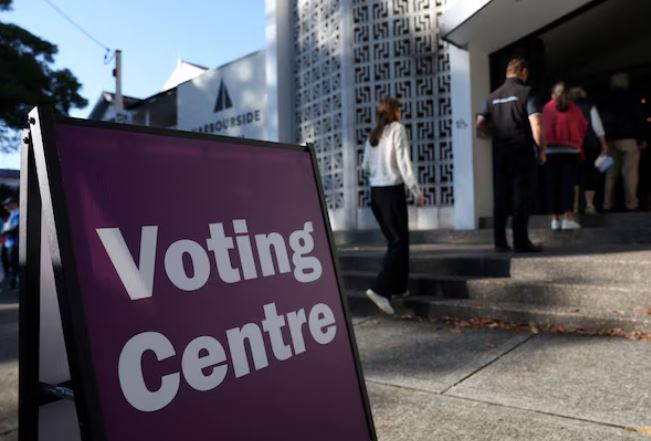
Polls have closed in Australia’s eastern states in a national election campaign dominated by cost-of-living concerns that’s being closely watched abroad for signs of a Donald Trump-inspired swing against conservative candidates.
Prime Minister Anthony Albanese of the Labor Party is facing off against Peter Dutton’s center-right Liberal Party, which is promising to get the country “back on track” after three years in opposition.
Albanese voted in his safe Labor electorate of Grayndler in Sydney early on Saturday afternoon, flanked by his son Nathan, fiancée Jodie and dog Toto.
Dutton cast his ballot alongside his family in the Brisbane electorate of Dickson, which he currently holds by a margin of just 1.7%. Labor is bullish about the chances its local candidate, Ali France, could end Dutton’s two decades in parliament.
The last polls close at 6 p.m. on the west coast (6 a.m. ET) and a result is expected within hours – if one of the major parties receives enough votes to win a coveted majority.
Pre-election national opinion polls firmed in Labor’s favor, but Australia’s preferential voting system and the declining dominance of the two major parties makes it difficult to predict who’ll make up the 150-member House of Representatives.
Observers will be examining the results for signs of blowback against Australia’s conservative candidates from US President Trump’s whirlwind 100 days in office – after comparisons were drawn between Dutton’s policy offerings and those of the US leader.
Another center-left prime minister, Mark Carney of Canada – which like Australia is a G20 and Commonwealth nation, as well as US ally – recently scored an election win widely chalked up to anti-Trump sentiment.
In Australia, almost half of the 18 million registered voters cast their ballots before election day, and the remainder are expected to attend voting centers to comply with compulsory voting laws, with the threat of fines for no-shows.
Polling centers on election day often resemble a series of small community fairs, taking advantage of the guaranteed flow of customers by selling what’s known as “democracy sausages” – a sausage, sauce, and maybe onions, on a slice of white bread.
The tradition began decades ago but in recent years has become more organized with an online map built by volunteers showing where voters can find a ballot box with a barbecue.
“Everybody has to show up to vote. As long as you’re showing up anyway, why not connect with the community through the fair-like atmosphere of a sausage sizzle and whatever other fundraisers are available on the day,” said Alex Dawson from the Democracy Sausage Team.
A warm Autumn Saturday allowed a dip in the ocean before voting for some, with many swimmers on Sydney’s Bondi Beach heading to the ballot box in their Speedos.
International influence
Over the last five weeks, the two major parties have been locked in a battle for votes, using the promise of tax cuts, rebates and other relief measures aimed at easing a cost-of-living crisis.
Australian elections tend to focus on domestic issues – housing, health and the economy – but this one has been influenced by international events.
Albanese called the election in late March, just before Trump announced his “Liberation Day” tariffs, sending global markets into a tailspin.
As with almost all other US allies, Australia was not spared from the tariffs, something Albanese criticized as “against the spirit of our two nations’ enduring friendship.”
On the campaign trail, the incumbent government has presented itself as a steady pair of hands as the initial hit to stocks broadened into fears of an impending global recession. Now, Labor says the Australian economy is turning the corner, pointing to a recent fall in inflation to 2.9%, the lowest since December 2021.
Source:CNN NEWS
About The Author
